
Lot 108
(1580 / 1645)
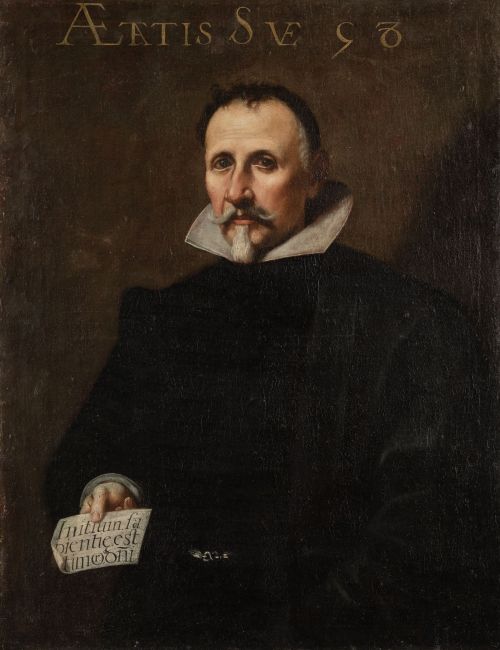
PEDRO ORRENTE Murcia (1580) / Valencia (1645) "Portrait of a gentleman with a ruff", c. 1620
Oil on canvas. On the reverse, affixed to the stretcher, is a label from the Board of Delegation for the Seizure, Protection, and Salvage of Artistic Treasures. An old chalk inscription reads "Albiz." Provenance: Collection of Maria Josefa Gutierrez-Maturana y Matheu-Arias-Davila, Countess of Albiz (until 1981); subsequently passed to its current owners. Portraits have, since their origin, served a legitimizing function, in which the person portrayed proudly displayed their lineage and social rank. In Spanish Golden Age painting, portraiture ceased to be the exclusive domain of the ruling classes thanks to a new concept of "portraability" and a new appreciation of "virtus," in which anyone was deemed worthy of being portrayed based on their personal virtues, such as an exemplary life, moral integrity, or brilliance in their work. Francisco Pacheco himself states in his treatise that nobility and lineage were no longer the primary criteria for someone to be portrayed. One of the most significant examples is the "Ingenios" (Witnesses) series by Van der Hamen (1596-1631). In the year of his death, twenty bust portraits of illustrious figures were inventoried among his possessions. These portraits, conceived as a group in themselves, represented various writers of the Spanish Golden Age, such as Quevedo, Gongora, Lope de Vega, and Ruiz de Alarcon. The surviving examples of this series share similar characteristics with this portrait, which must have been painted around the same time, in the 1920s. They all generally share the same features: the subjects are depicted in bust or three-quarter view, emerging from a neutral background and accompanied by an inscription or text alluding to their identity. These works were grouped in the great collections of the 17th century, within galleries dedicated to illustrious men. One example is the collection that the Marquis of Leganes kept at his villa in Morata. We do not know the identity of the person depicted here, and the only information we have about him, thanks to the inscription at the top, is that he was 57 years old when he was painted. His black clothing against the neutral background makes his face stand out and draws all the attention of the work. The detailed treatment of his features and its naturalism lead us to believe that it is a portrait painted directly from life. The cartouche with the Latin inscription "Initium sapientiae timor Domini" (The fear of the Lord is the beginning of wisdom), taken from the Book of Proverbs (9:10), was sometimes used as a motto in religious or educational institutions, suggesting that the subject of the portrait must have been involved in similar pursuits. The short, loose brushstrokes that mold the strands of his hair and the hair on his face,The impasto used in the flesh tones, the rendering of the eyes with white outlining of the lower eyelid, and the treatment of the background lead us to attribute the painting to Pedro Orrente. Several works by him are known that are very similar in conception and in which the same technique can be appreciated, such as the Self-Portrait in the Prado Museum, which belonged to the Dukes of Montpensier (P003242), and the Portrait of a Gentleman with a Ruff, from a Valencian noble collection, which was sold some years ago. The same technique and types can be seen in some of the figures in his large compositions from the Toledo period, such as the Miracle of Saint Leocadia of 1616.
Starting price 16.000 €
NOT SOLD
Recomended lots
Confirm
You are bidding €
At the time of auction we will contact you by phone:
You accept the conditions of the room by confirming your bid
Loading…
Conecting with the server
Are you sure you want to buy the lot?