
Lot 695
(1661 / 1724)
LUCAS VALDES Seville (1661) / Cadiz (1724) "Biblical Scenes from the Story of Samson", 1687
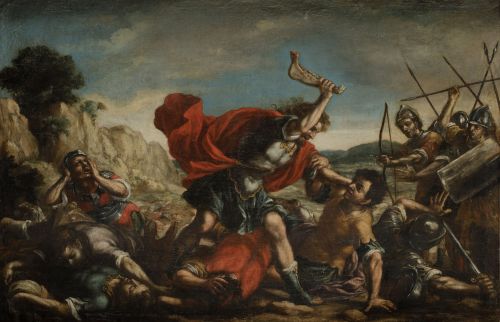
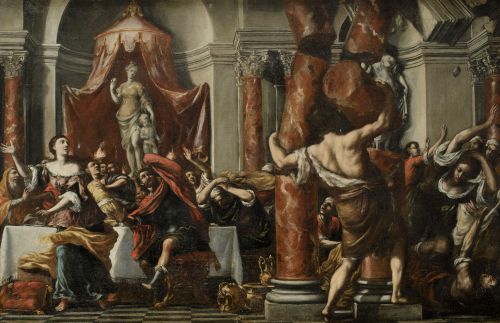
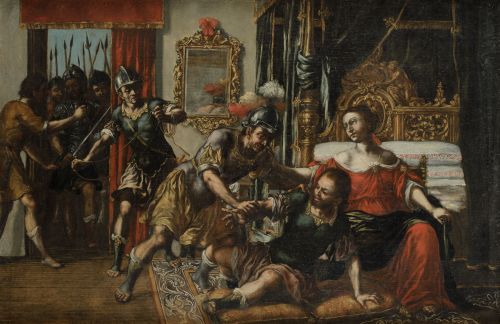
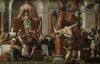
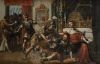
Series of three oils on canvas. Bibliography and exhibitions: Catalogue of the second exhibition of 17th-Century Andalusian Painting in Barcelona Collections, Sala Pares, Barcelona, 1947-1948, nos. XVIII, XIX and XXVII; VALDIVIESO, E., Historia de la Pintura Sevillana. Siglos XIII al XX, Seville, 1986, p. 294; FERNANDEZ LOPEZ, J., Lucas Valdes (1661-1725), Diputacion de Sevilla, Servicio de Archivo y Publicaciones, Seville, 2004. In the first two decades of the 18th century, the Seville school of painting was dominated by the figure of Lucas Valdes. The son of the celebrated Juan de Valdes Leal (1622-1690), he was one of the few artists who worked outside the prevailing trend of Murillo-inspired imitation, cultivating a style heavily indebted to that of his father, with whom he trained and collaborated on numerous commissions. After his father's death in 1690, he inherited his workshop and received the principal commissions in the city of Seville until 1719, when he settled in Cadiz. His activity as a painter of grandiose mural scenography can be seen in this series of canvases depicting scenes from the life of Samson. As in the rest of his output, the colour palette is dominated by reds and blues, in compositions in which the artist recreates highly dramatic scenes crowded with figures, with exaggerated expressions and complex foreshortening. Its date of execution coincides with the period when he was working with his father on the decorative scheme for the Church of los Venerables, a fact which explains the effort Lucas Valdes made to emulate his father's style in these canvases, which stand out for their pictorial quality when compared with other works from his extensive output. “Samson Defeats the Philistines”. Signed in the lower right corner: “D. Lucas de Valdes faciebat”. On the reverse, an old exhibition label. The first canvas in the series, following the chronological order of events, depicts the moment when Samson defeats the Philistines. Valdes sets the scene in an open mountainous landscape with a wide expanse of sky, in which the protagonist occupies the central compositional space. Characterised by his long hair, he is shown in an attacking pose, wearing a red cloak billowing in the wind. The sacred texts recount that, after being seized to be handed over, Samson freed himself by breaking the ropes with his supernatural strength and, using the jawbone of a donkey, killed more than a thousand Philistines. In a highly dramatic scene, the painting shows him with this weapon in hand, delivering the fatal blow to a warrior, while some lie dead on the ground and others watch the event in utter terror. "Delilah Hands Samson Over to the Philistines". On the reverse, an old exhibition label. The second canvas, following the chronological order, is set inside a bedchamber and captures one of the best-known episodes in this figure's story. According to the sacred texts, it was Delilah, a Philistine woman renowned for her beauty, who succeeded in making Samson weaken. She seduced him with the sole aim of discovering the secret of his strength and, although Samson gave her false clues several times, he eventually succumbed to her charms, confessing that the secret of his strength lay in the fact that his hair had never been cut. As depicted in this painting, Delilah lulled him to sleep in her lap and had a servant shave his head, thereby weakening him and delivering him into the hands of the Philistines, who gouged out his eyes and imprisoned him. "Samson Destroys the Temple of the Philistines". Signed and dated in the lower right corner: “D. Lucas de Valdes faciebat. 1682”. The third canvas in the series has the most theatrical character of the three, recalling the painter's skill in rendering complex mural scenography. The sacred texts recount how the Philistine leaders gathered in the temple to celebrate Samson's capture and offered a sacrifice to their god Dagon. They had Samson brought before the assembly to be mocked and to entertain the crowd. As he had been left blind, he asked the young man guiding him to lead him to the temple's main columns so that he could lean against them, and there he asked God to grant him strength one last time to avenge himself upon the Philistines. With all his might he pushed the columns and brought down the temple, killing everyone present, including the principal Philistine leaders. Measurements: 81.5 x 123.5 cm. each
Starting price 30.000 €
Leave your maximum bid here, before it is up for auction
Recomended lots
Confirm
You are bidding €
At the time of auction we will contact you by phone:
You accept the conditions of the room by confirming your bid
Loading…
Conecting with the server
Are you sure you want to buy the lot?