
Lot 646
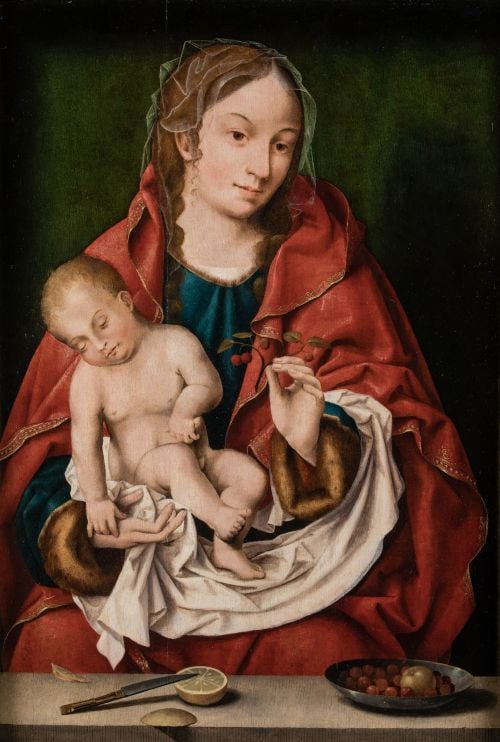
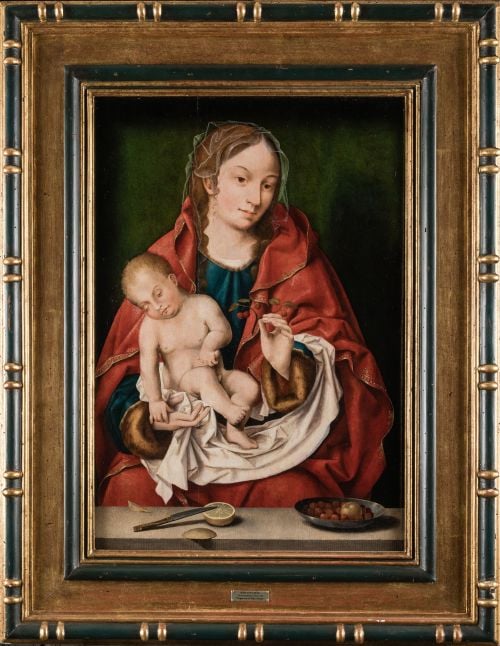
JOOS VAN CLEVE Antwerp, Belgium (1485 / 1540-41) "Madonna a
Oil on panel. Provenance: - Richard Von Kaufmann Collection (d. 1908); Cassireer and Helbing Sale, Berlin, December 1917; Berlin, Von Der Heydt Collection; Von Der Heydt Heirs. Von Kauffmann'collection of painting, sculpture and other works of art, which was dispersed in different sales at the end of 1917, included an important group of 16th-century European paintings, and according to the director of the Royal Museums of Germany, Wilhelm Von Bode, was difficult to surpass in Germany. This collection included paintings such as: "The Mystic Marriage of Christ" by the Master of the St. Bartholomew Altarpiece (Washington DC National Gallery of Art); a "Nativity" by Gerard David (Cleveland Museum of Fine Arts); Martin von Heemskerk' "Jupiter" and "Samson Slaying the Philistines", both in the Ashmolean Museum, Oxford; two pinnacles from the "Annunciation of the Virgin" by Paolo Veneciano and Lorenzo Lotto' "Portrait of a Jeweler", all in the J. Paul Getty Museum, Los Angeles; as well as paintings by artists such as Benvenuto di Giovanni, Boticelli, Van der Weyden, Jacob van Amsterdam, Holbein, and Cranach the Elder. Joos Van Cleve was a member of the Antwerp guild from 1511, achieving great prestige as a portraitist and painter of religious subjects with Renaissance elements. He painted at the court of Francis I in France and at the court of Henry VIII in England in his own style, based in his early works on that of his compatriot Jan Joes van Kalkar. Trained in the Mannerism of Antwerp and influenced by the environment of Bruges, it is thought that he traveled to Italy for the Leonardesque elements in his paintings. His compositions are delicate and gentle, executed with extreme care, especially his Virgins have a very personal charm. This painting has been considered by Von Baldass and Friedländer (see bibliography) as the first version of a composition of 1520. There is a small group of similar paintings considered to be from the studio that are in the Museum of Fine Arts in Troyes, in the Royal Museum of Fine Arts of Belgium and in the Gallery of the Palazzo Bianco in Genoa. All these works differ in the lack of a border in the foreground and in that the gaze of the Virgin is directed downwards looking at the Child, instead of looking straight ahead. Furthermore, the last two have very similar landscape backgrounds on the right, seen from a scalloped edge, and a column on the left. The composition follows traditional schemes: the Child appears on the left, in his mother'right arm, reclining and sleeping on a white cloth. He displays the sentimental outpouring of Marian iconography of the time, which highlights the expression of motherhood and filial intimacy. It presents various iconographic attributes, such as the lemon, a symbol of incorruptibility, and cherries.derivation like other fruits of the small sphere placed in the hands of Jesus or the Virgin to express their greatness and power. Bibliography: - L. Von Baldas, "Joos Van Cleve, the Master of the Todes Mariae", Vienna, 1925, p. 21, no. 33 (as of circa 1520). - M.J. Friedländer "Early Netherlandish Paintings, IX: Leiden and Brussels, 1972, p. 60, no. 52, fig. 66. Dimensions: . Measurements: 81.3 x 56.5 cm
Starting price 78.000 €
NOT SOLD
Recomended lots
Confirm
You are bidding €
At the time of auction we will contact you by phone:
You accept the conditions of the room by confirming your bid
Loading…
Conecting with the server
Are you sure you want to buy the lot?