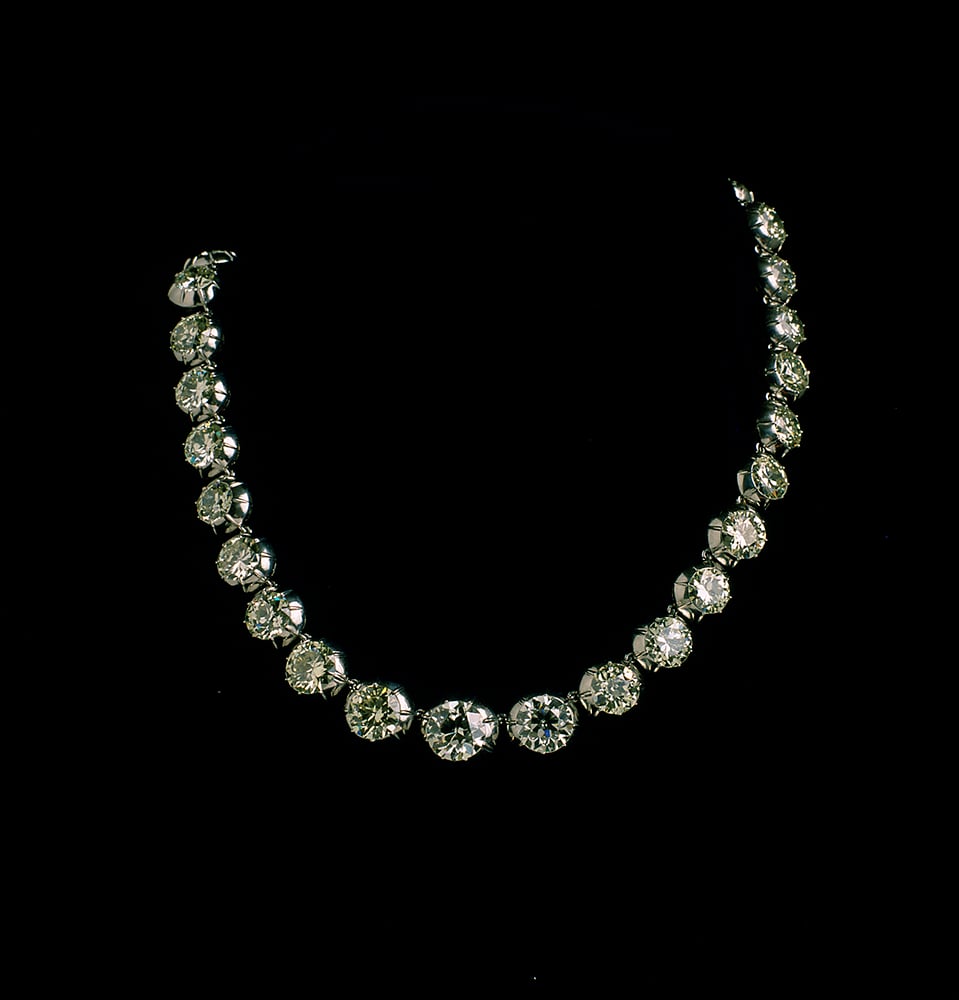
The origin of this emblematic piece dates back to 1906, when King Alfonso XIII gifted his fiancée, Princess Victoria Eugenie of Battenberg, an exceptional choker created by Ansorena.
The original piece was composed of 30 diamonds of extraordinary quality, with a total weight of 90 carats, set in chatons, also known as the “Russian setting.” In this technique, each diamond is mounted on a fine platinum base and secured with delicate, almost invisible prongs, allowing light to pass through with maximum brilliance.
Together with the Fleur-de-Lys tiara, it was one of the wedding gifts the future queen received from King Alfonso XIII.
Alfonso XIII turned this jewel into a symbol. Each time he wished to give the Queen a gift, he would present her with two new diamonds. Victoria Eugenie would have them added to the original choker, gradually extending its length until it reached an extraordinary scale—falling to the waist and even allowing it to be worn doubled around the neck. Its versatility made it suitable for different styles and occasions with effortless elegance.
Over time, Queen Victoria Eugenie decided to divide the chatons into two separate necklaces, ensuring their preservation and continuity.
This group of jewels became known as “the passing jewels,” pieces intended to be handed down from generation to generation within the royal family, as a symbol of continuity, history, and tradition.
Beyond its historical significance, the chaton necklace stands as a classic of high jewelry: individually set diamonds in platinum that maximize the flow of light and create a balanced, timeless result. A design that emerged in the 19th century, was refined in the 20th, and remains fully relevant today.
At Ansorena, this piece is not just part of history—it is part of our identity. A reflection of how jewelry can transcend time and become a lasting legacy.
Related posts